
🚀 Stop guessing your grades!
Our free Class Rank Calculator helps you:
✅ See exactly where you stand among your classmates
📊 Check your GPA and class rank instantly — with imaginative “what-if” scenarios
🏅 Track your progress and reach the top faster — simple, fast, and accurate!
🎓 Try All 3 Smart Class Rank Calculator Modes for Accurate Results
Quickly find your standing with our three smart calculator modes, designed for every student level. Get fast, accurate GPA and rank results — from simple estimates to detailed academic insights.
⚡ Simple Mode — Quick Rank & GPA in Seconds:
📘 Course Details Mode — Advanced Weighted GPA Insights:
👉 Read More →
🎯From Rank Mode — Track Progress & Set GPA Goals:
Already know your class rank? Use this mode to predict your future GPA based on current trends, compare how your GPA stacks up over time, and plan targeted strategies for next semester’s improvement. This feature helps goal-oriented students focus their efforts to reach the top 5%. Start using Rank Mode today to achieve your academic goals!
🎓 Class Rank Calculator
Advanced+ Final Version - Accurate GPA & Rank Estimator
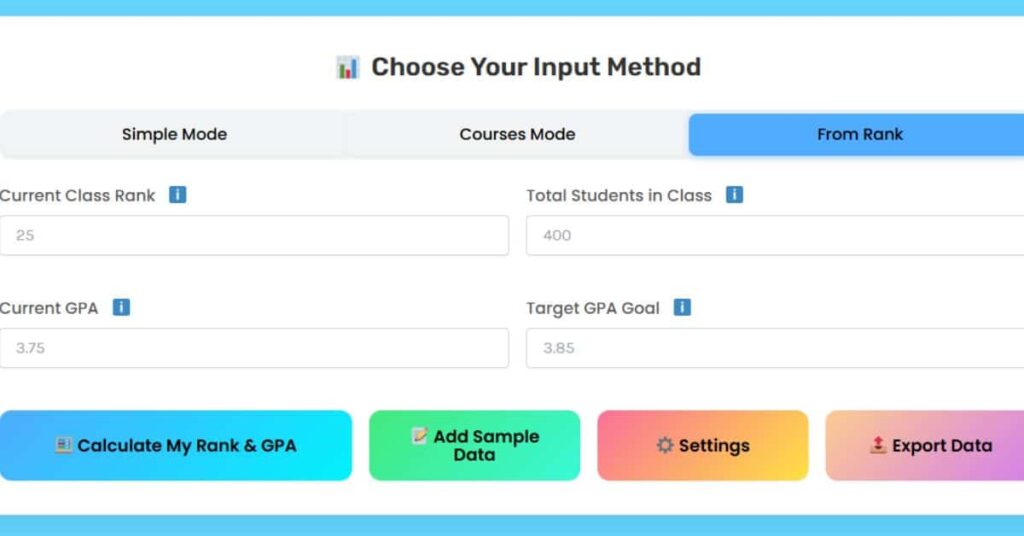
📊 Choose Your Input Method
🔮 What-If Scenarios ℹ
📋 Scenario Comparison
| Scenario | Weighted GPA | Estimated Rank | Percentile | Status |
|---|
📈 Your Academic Standing
📊 Academic Progress Visualization
📚 Calculation History ℹ
| Date/Semester | Current GPA | Weighted GPA | Rank | Status | Courses | Action |
|---|
⚙️ Calculator Settings
🎯 Why Class Rank Matters for Students
Class rank shows how your performance compares to others at your school. Colleges and scholarships use it to judge effort, consistency, and course choices.
Scholarship Eligibility
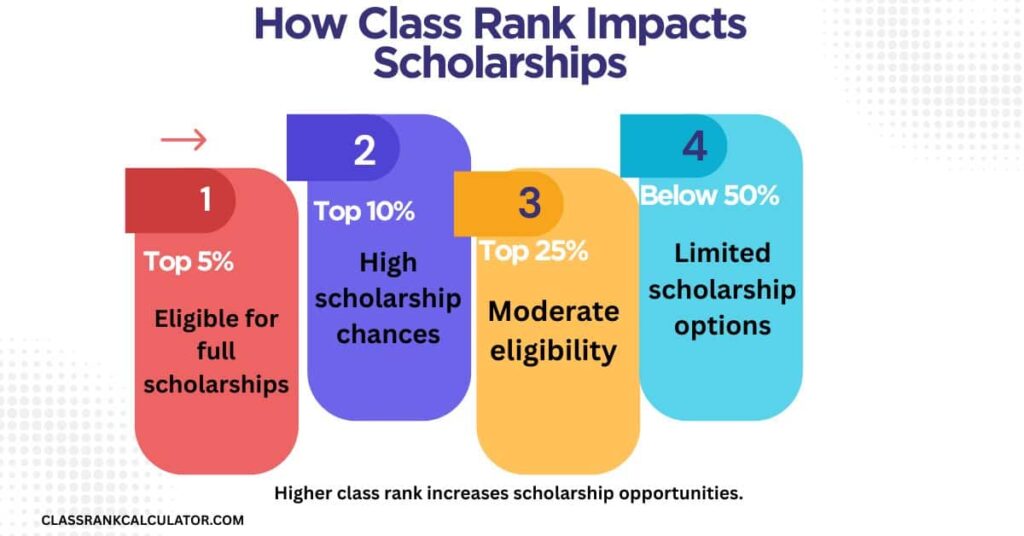
Many scholarships look at class rank to identify strong students. With a higher rank, your chances of earning financial support increase. Certain programs even require you to be in the top 5% or 10% to qualify
College Admissions Advantage

When comparing applicants from different schools, colleges often use class rank. Standing out in admissions becomes easier with a solid class rank, as it highlights your hard work and consistency each semester. Students within the top 10% frequently gain a competitive advantage at many universities.
Academic Competition
Class rank motivates students to maintain focus, fueling friendly competition and offering a clear way to track progress. Watching your position rise can increase confidence and inspire higher goals.
Course Planning and AP/Honors Decisions
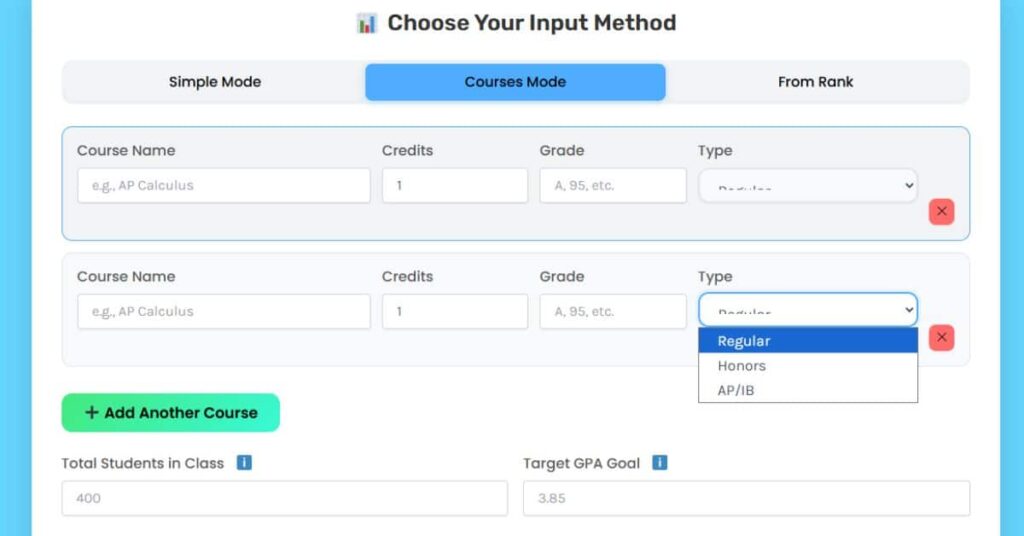
Class rank guides course selection, too. Students hoping to climb the ranks may take AP, IB, or honors classes, which boost weighted GPA. Careful course planning can help raise your rank and reinforce your college profile.
Use the Class Rank Calculator below to check how your GPA, courses, and class size affect your rank and percentile
🧮 How to Calculate Your Class Rank Step by Step
Class rank shows your position in the class based on GPA and academic performance. To understand how class rank is calculated, it helps to review the typical methods schools use. Following these steps can help you track progress and set realistic goals.
Exact Calculation Method
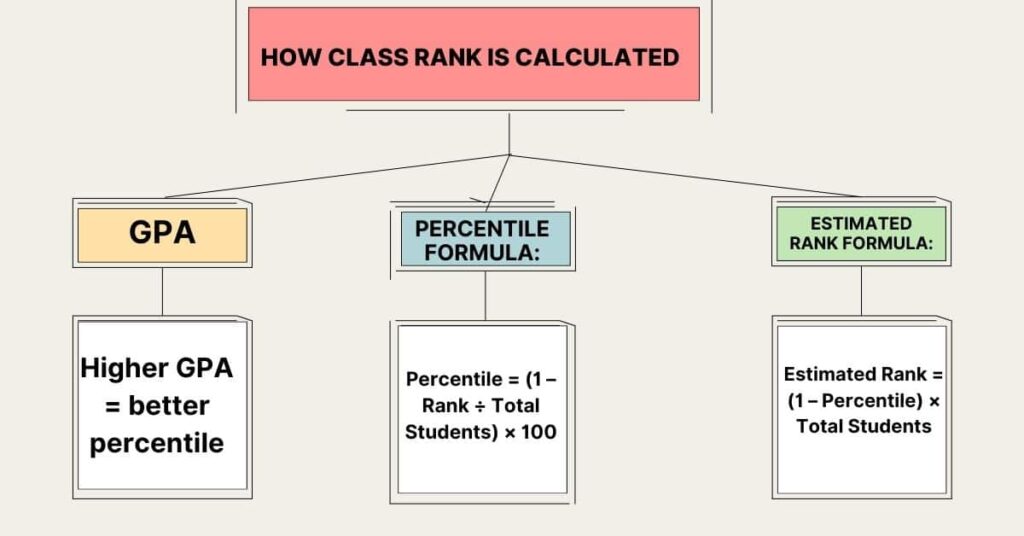
To calculate class rank, schools compare every student’s GPA and create a list from highest to lowest; your place on this list becomes your class rank, with the student holding the highest GPA positioned at Rank #1.
Rank Estimation Formulas
If you want to estimate your class rank at home, you can use a simple formula.
Rank Estimate:
Estimated Rank = (1 – Percentile) × Total Students
Percentile Formula:
Percentile = (1 – Rank ÷ Total Students) × 100
These formulas are useful because they help you see just how small changes in your GPA can affect your position in the class.
Weighted vs. Unweighted Factors
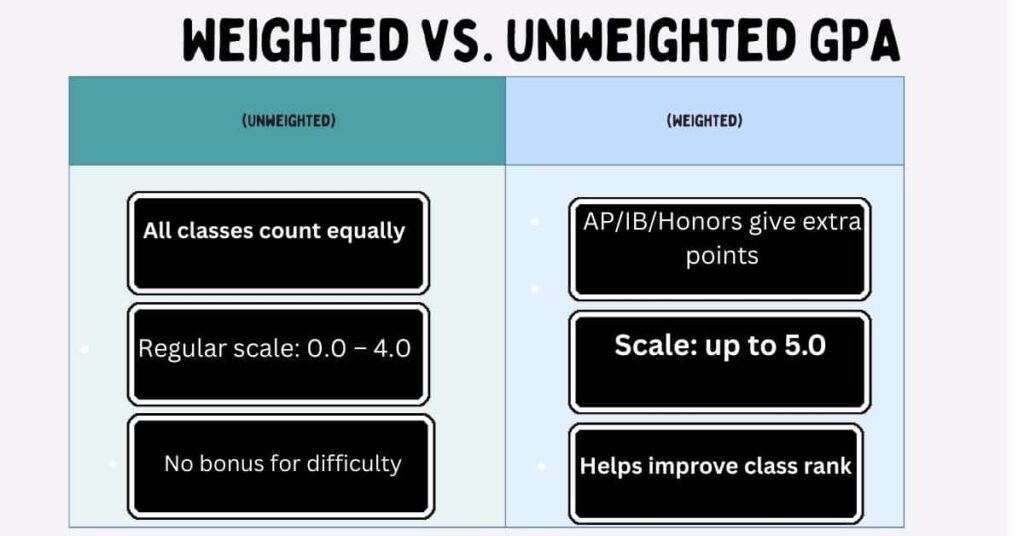
Since an unweighted GPA treats every class the same, all courses contribute equally to your score.
If you take AP, IB, or Honors classes, a weighted GPA adds extra points for these advanced courses.
By enrolling in advanced courses, your weighted GPA can improve and potentially increase your class rank.
Example Calculation: GPA 3.75 with Class Size 400
A student with a 3.75 GPA in a class of 400 students will often find themselves in the top 5–10 percent of the class.
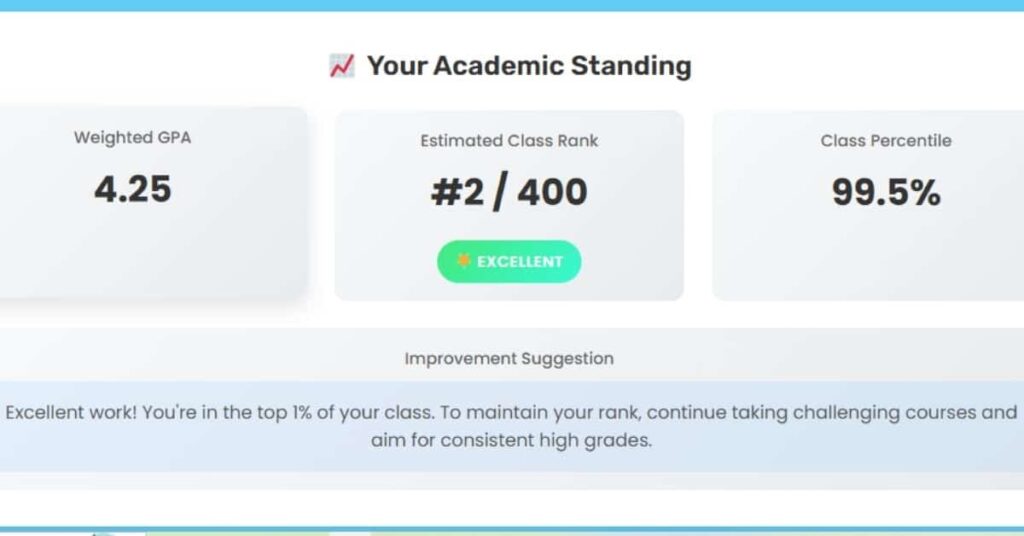
When the same student takes AP or Honors classes, their weighted GPA may rise to 4.25, a score that can move them into the top 1 percent.
Your Class Rank Calculator shows:
- Weighted GPA: 4.25
- Estimated Rank: #2 / 400
- Percentile: 99.5%
This example shows how a weighted GPA can improve your standing.
Use the Class Rank Calculator below to estimate your GPA, rank, and percentile using simple or advanced input methods.
🎓 What Is Class Rank & Why It Matters
Have you ever wondered how you measure up to your classmates? Class rank shows where you stand compared to others in your grade. It is based on your academic performance and helps schools see your overall position in the class. A lower rank number means stronger performance.
Class Rank, GPA, and Percentile—The Difference
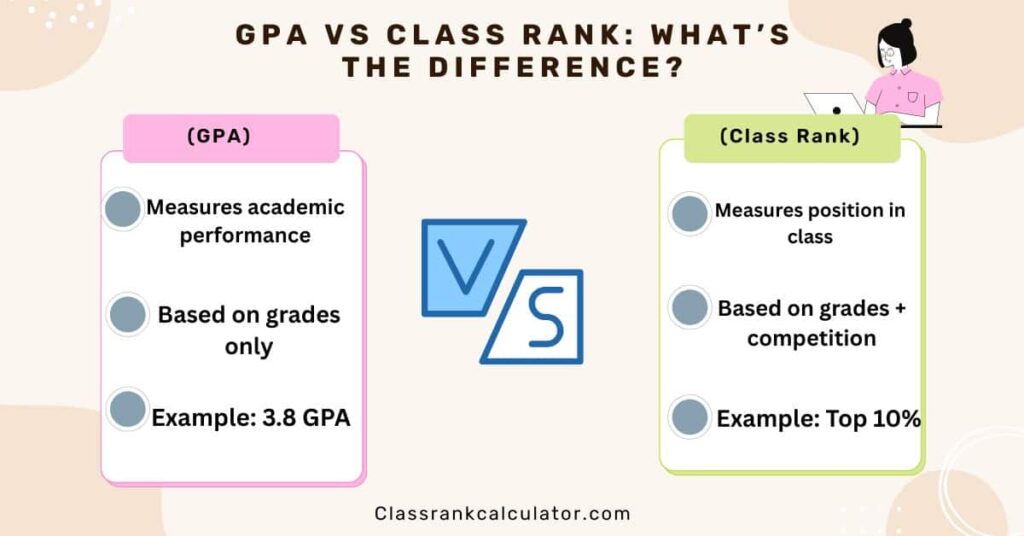
Do you know what your GPA says about you? It shows your average grades. And what about your class rank—where do you think you fall among all students? Have you ever checked your percentile to see how many students you outperformed? For instance, if you’re in the 90th percentile, you did better than 90% of your classmates.
How Colleges View Class Rank
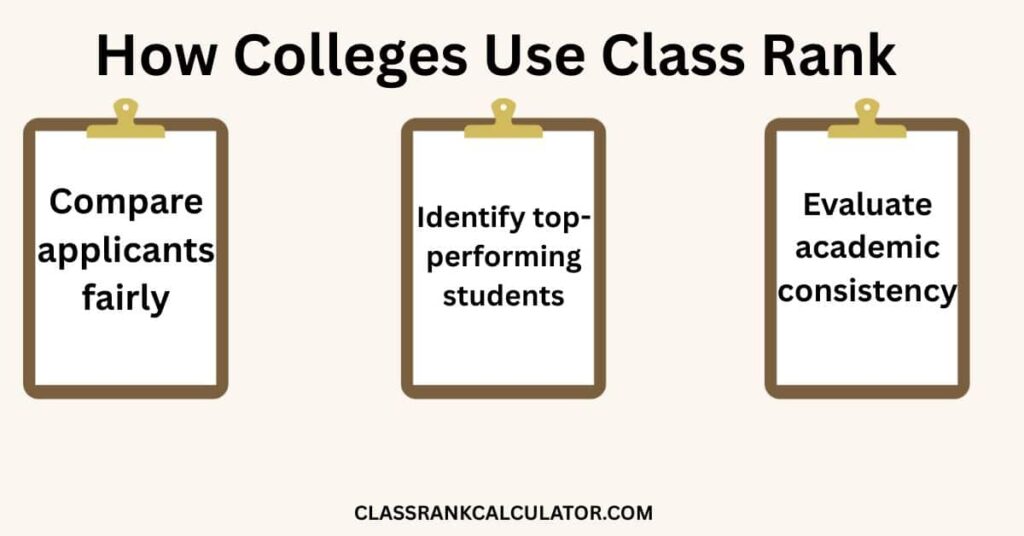
Ever wondered how colleges quickly size up your academic performance? Many U.S. colleges use class rank to understand academic strength quickly. It helps them compare students from different schools. A high rank shows consistency, effort, and strong coursework. Some colleges also check weighted GPA to review advanced classes like AP, IB, or honors.
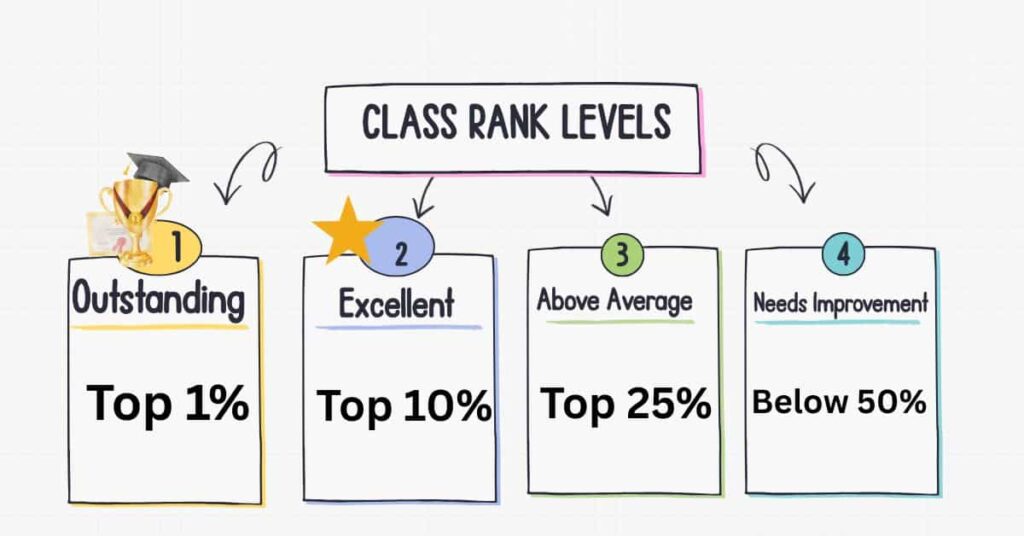
To give you context for your own ranking, here are examples of common rank groups:
| Percentile | Meaning |
|---|---|
| Top 1% | Elite performance |
| Top 10% | Excellent academics |
| Top 25% | Above average |
| Top 50% | Average standing |
These groups help students understand how competitive their profile is for college admissions.
You can use the Class Rank Calculator below to find your GPA, rank, or percentile based on simple input options
⚖️ Weighted vs Unweighted GPA: Key Differences for Students
Knowing the difference between weighted and unweighted GPA helps you choose classes that make the most of your academic strengths and raise your class rank. Focus on weighted GPAs if you want advanced coursework to boost your GPA; focus on unweighted if you want consistency across all classes. Schools use both measures when considering academic strength and course difficulty.
What Is a Weighted GPA?
When you take AP, IB, and Honors courses, a weighted GPA gives extra points because these classes carry more difficulty. As students challenge themselves, schools offer rewards, and as a result, a weighted GPA may rise above 4.0, depending on the school’s scale.
How AP, Honors, and IB Credits Impact GPA
AP and IB classes usually add +1.0 points, while Honors adds +0.5 points. Example:
Regular A = 4.0
Honors A = 4.5
AP/IB A = 5.0
These extra points can significantly boost your GPA and improve your class rank.
Regular vs Weighted Courses Example
Imagine you’re a student taking only regular classes—you might have a 3.75 GPA. Now picture yourself with AP and honors classes. Your weighted GPA could jump to 4.25, just like your calculator shows. This difference can move a student from the top 10% to the top 1% in many schools.
Which GPA Improves Your Rank?
Since weighted GPA rewards advanced coursework, it helps rank more. Students enrolled in AP, IB, or honors classes often hold stronger GPAs and climb to higher class positions.
Your calculator clearly demonstrates this:
Weighted GPA: 4.25
Rank: #2 / 400
Percentile: 99.5%
Advanced courses directly improve rank, even when the unweighted GPA stays the same.
“Use the Class Rank Calculator below to see how regular, Honors, and AP courses affect your weighted GPA and rank.”
🔮 Boost Your Grades Faster with “What-If” Class Rank Scenarios
“What-if” scenarios let you preview potential grade changes before they occur. This feature demonstrates how a single improvement can shift your GPA, weighted GPA, and class rank. It helps you plan strategically and pinpoint the steps that most efficiently boost your academic standing.
Scenario Meaning
A “What-If” scenario models a future grade, course change, or GPA shift. Add up to three scenarios to directly compare them with your current results. See how one grade, course, or goal can transform your performance.
How 1 Grade Change = Rank Boost
Small shifts can trigger significant ranking leaps. For example, your calculator shows:
Current GPA: 3.75
Weighted GPA: 4.25
Rank: #2 / 400
If a single course grade rises, even slightly, your weighted GPA increases—often elevating your rank by several positions. One A in a rigorous course can boost your percentile from 97% to 99%, depending on peers.
AP & Honors Impact Scenarios
Advanced courses create even greater “what-if” improvements. Example from your Courses Mode results:
AP Calculus (A) = strong GPA boost
Honors English (92) = +0.5 weighted gain
Regular courses = normal impact.
When AP or Honors grades climb, ranks advance more quickly because advanced credits add weight. Your tool displays this clearly:
Weighted GPA: 3.95
Rank: #11 / 400
If an AP grade increases, your rank could instantly enter the top 5%.
Max 3 Scenarios: Best Use Cases
Here are the three scenarios students use the most:
“Raise one course grade.” See how improving a single class shifts your rank.
“Add or adjust an AP or Honors class.” Test how advanced courses impact your weighted GPA.
“Set a target GPA goal.” Enter a goal like 3.85, then see what steps you need to reach it.
Our calculator’s “Add Scenario” button lets you compare up to three scenarios side-by-side.
Use the Class Rank Calculator below to test ‘What-If’ scenarios and see how grade changes, AP, or Honors courses can boost your weighted GPA and class rank instantly
🚀 Tips to Improve Your Class Rank Quickly
Tips to Improve Our Class Rank Fast
Boosting class rank takes time. Use these strategies to improve your GPA fast.
1. Take AP or Honors Courses
Advanced classes add extra points to your weighted GPA, which can increase your class rank more quickly than standard classes. Your calculator shows that taking AP or honors courses may place you in a higher percentile faster, directly impacting your class standing. Example: Taking AP Calculus or Honors English instead of regular courses can increase your rank in a shorter time by raising your GPA.
2. Improve Low-Grade Subjects
Focusing on improving low-grade subjects can quickly boost your GPA and, as a result, improve your class rank. Even small grade increases in just one course can raise your GPA and shift your class rank upward, as your calculator demonstrates.
3. Make a Semester-Wise Study Plan
Breaking your academic year into smaller goals makes improvement manageable and helps you achieve a higher GPA each term. Planning assignments, tests, and extra credit in advance ensures you never miss opportunities to raise your grades and rank. Tracking progress each semester lets you catch dips early and keep your GPA and rank moving upward.
4. Track GPA & Rank Every Term
Checking your GPA and rank at the end of every semester allows you to measure progress toward your desired standing. Using your Class Rank Calculator helps you see how potential grade changes will move your class rank, letting you set concrete goals. Regular tracking helps you find weak areas so you can focus efforts for the biggest impact on your GPA and class position.
5. Use the Calculator Weekly
Adding new grades or courses each week helps you see progress and identify areas to optimize for a faster rank increase. Testing ‘what-if’ scenarios lets you spot which grade improvements will most effectively boost your class rank. Using these tools proactively helps you stay ahead, make informed decisions, and rapidly climb in class rank.
“Use our Class Rank Calculator below to track your GPA, simulate improvements, and discover which strategies can boost your class rank fastest.”
⚠️ Common Mistakes Students Make When Calculating Class Rank
Do you know if you’re calculating your class rank correctly? Many students make avoidable errors that can distort their academic standing.
1. Ignoring Course Credits
Course credit values vary between classes, so pay close attention. Course credits reflect the importance or workload of a class (for example, a full-year course may be worth 1.0 credit, while a one-semester course may be worth 0.5 credit). Ignoring credit weight, which is the impact each course’s credits have on calculations, can misrepresent your GPA and rank. Example: A 0.5 credit class counted as a full credit can inflate the rank incorrectly.
2. Incorrect Grade Weights
If you assign the wrong grade value, you cause errors. AP (Advanced Placement), IB (International Baccalaureate), and Honors courses have extra points (weighted grades) added to reflect their difficulty. Failing to add weighted points lowers your calculated GPA and rank.
3. Wrong Class Size
Class rank depends on the total number of students. If you enter the wrong class size, you make your percentile and rank inaccurate.
4. Mixing Weighted and Unweighted GPA
Many people confuse weighted and unweighted GPAs. Always make sure you input the GPA type you want to calculate into your calculator. Weighted GPA usually improves your rank, while unweighted GPA does not.
5. Target GPA Estimation Mistakes
If you set unrealistic target GPAs or miscalculate required grades, you frustrate yourself. Use the calculator’s “Target GPA” feature for accurate planning.
“Use our Class Rank Calculator below to avoid common mistakes and accurately calculate your GPA, weighted GPA, and class rank.”
🎯 Benefits of Using a Class Rank Calculator
A class rank calculator is a powerful tool to track your academic performance. It makes GPA and rank management easier and faster.
1. Accurately Assess Your Academic Standing
Track exactly where you rank in your class. Stop guessing and rely on precise GPA and rank calculations.
2. Understand Your Class Percentile
Find out your exact percentile, such as top 1%, 5%, or 10%. Use this for your scholarship and college plans.
3. Faster Decision-Making for Course Selection
Check quickly how new courses would affect your GPA and rank. Choose the AP, Honors, or regular classes that are best for you.
4. Helps with GPA Improvement Planning
Plan your steps to reach your target GPA. Use “What-If” scenarios to simulate grade improvements.
5. Teacher/Counselor-Friendly Data Export
Export your results easily when you attend guidance meetings. Track your semester progress and share reports with your counselor or teachers.
“Use our Class Rank Calculator below to track your GPA, simulate improvements, and make smarter academic decisions fast.”
🎓 How Class Rank Helps in College Applications
Class rank is more than a number—it actively shows colleges your academic standing, the rigor of your courses, and trends in your GPA. Calculate these to clarify your strengths.
1. Colleges Look at Percentile, GPA Trend, and Course Rigor
Admissions officers value students in the top percentiles with strong GPA trends. AP, Honors, and IB classes improve weighted GPA and demonstrate course rigor.
2. Top 10% & Top 25% Admission Advantages
Rank in the top 10% or 25% to qualify for scholarships or automatic admissions at certain schools. Use your calculator to pinpoint your standing.
3. Reporting Rank on the Common App
Use accurate data from your calculator to report the rank. Include weighted GPA and percentile if your school provides them.
4. When Colleges Consider “Unranked Schools.”
Some schools don’t provide a rank. Use the percentile and GPA trends from your calculator to show your academic standing clearly.
5. Improving Your Profile Without Rank
If your school doesn’t rank, emphasize your GPA, AP/Honors courses, and test scores. Leverage your calculator’s “What-If” scenarios to plan and execute your academic improvements strategically.
“Use our Class Rank Calculator below to see your GPA, percentile, and rank trends, helping you strengthen your college applications.”
🎯 Academic Goal Setting With Your Class Rank
Setting academic goals starts with understanding your current GPA, weighted GPA, and class percentile. Your calculator makes this easy and actionable.
1. Set Target GPA Based on Current Percentile
Identify your current percentile using the calculator. Set a realistic GPA goal to reach the top 10%, 5%, or 1%. Example: Current GPA 3.75 → target GPA 3.85 → rank improves from #25 to #11 / 400.
2. Create a Semester Improvement Roadmap
Plan each semester with clear, achievable milestones that help you celebrate every step forward. Your tool tracks GPA versus rank trends, guiding you to focus on courses that present the best opportunities for improvement.
3. Identify Weakest Subjects
Use the Courses Mode within Rank Calculator to see grades by subject. Focus on improving lower-score classes to make the greatest positive impact on your rank.
4. Match Goals With AP/Honors Course Load
Advanced courses can quickly boost your weighted GPA and highlight your determination. Your calculator shows the exact impact of AP/Honors grades on overall rank.
5. Use “What-If” Scenarios for Semester Planning
Simulate up to 3 scenarios using the Rank Calculator to see how grade changes affect rank. Plan smarter and celebrate your progress every week.
“Use our Class Rank Calculator below to set academic goals, track GPA improvements, and plan strategies to boost your class rank effectively.”
🎓 Scholarship Eligibility Based on Class Rank
Class rank plays a big role in qualifying for scholarships. Knowing your percentile helps you focus on the awards you can realistically earn.
1. Merit-Based Scholarship Thresholds
Many scholarships require that you be among the top-ranked students. For example, the top 5% or the top 10% may qualify automatically. Your calculator shows your rank (#2, #11, #25 / 400) and percentile (99.5%, 97.3%, 93.8%), making eligibility clear.
2. Top 5%, 10%, 15% Scholarship Criteria
Different scholarships have different cutoffs:
Top 5% → full tuition or large merit award
Top 10% → partial merit award
If you are in the top 15%, you may qualify for smaller awards such as merit scholarships or college-specific grants. Consider your rank percentile when shortlisting your options.
3. Community Scholarships That Check Class Standing
Local organizations, clubs, and foundations often require you to provide proof of your rank. Your tool can export GPA & rank history to meet these requirements.
4. GPA/Rank Combination Requirements
Some scholarships need both a high GPA and a top rank. Example: Weighted GPA 4.25 + rank #2 / 400 → eligible for full merit awards. The calculator helps track and plan to reach these benchmarks.
5. Use Rank to Pick the Right Scholarships
Avoid wasting your time applying for scholarships beyond your reach. Filter awards based on your current GPA and percentile using your calculator.
“Use our Class Rank Calculator below to see your percentile, plan for scholarships, and determine which awards you’re eligible for based on your GPA and rank.”
📘 Tips for Academic Success with Your Class Rank
1. Study Consistently
3. Take High-Quality Notes
4. Join or Form Study Groups
5. Ask Questions Confidently
6. Review Lessons Daily
7. Stay Organized
9. Review Previous Tests & Quizzes
10. Use GPA/Rank Tools Weekly
“Use our Class Rank Calculator weekly to track GPA, simulate improvements, and apply these academic success tips effectively.”
💡 Got Questions? We’ve Got Answers
Have questions about how the Class Rank & GPA Calculator works? You’re not alone — we’ve covered everything students usually ask.
Find quick, clear answers that help you get the most accurate results every time.
Read More →
🎯 Why Students Love Our Class Rank & GPA Calculator
Read More →
🎯 Ready to See Where You Stand?
Read More →
📚 Resources & Guides
Read More →
📢 Stay Updated — Join Our Free Student Newsletter
Read More →
🔎 Explore More Tools
Read More →
📊 See How Your GPA Affects Your Class Rank
Read More →
💡 Why Students Love It
⚡ Instant Results — Get your GPA & rank in seconds.
📱 Mobile Friendly — Works smoothly on phones, tablets, & computers.
🔒 Privacy First — No login, no tracking, your data stays with you.
💬 What Students & Teachers Are Saying
Discover how this simple tool helps improve study plans and academic progress.
🧮 GPA Improvement Planner
Not happy with your current GPA? Plan your progress like a pro.
Set your target GPA, find the grades you need, and track your improvement each semester.
Read More →
🌟 Real Students, Real Results
See how real students improved their GPA and class rank using our calculator.
Read inspiring success stories that prove how small changes can lead to big results.
Read More →
📚 Tools for Counselors & Educators
Help your students plan smarter and aim higher.
Our Class Rank & GPA Calculator makes it easy for teachers to track rank, GPA trends, and course impact.
Read More →
💡 More Helpful Tools for Students
If you use Canvas LMS, try Canvas Grade Calculator — it lets you instantly calculate grades and GPA directly from your Canvas courses with complete accuracy.
